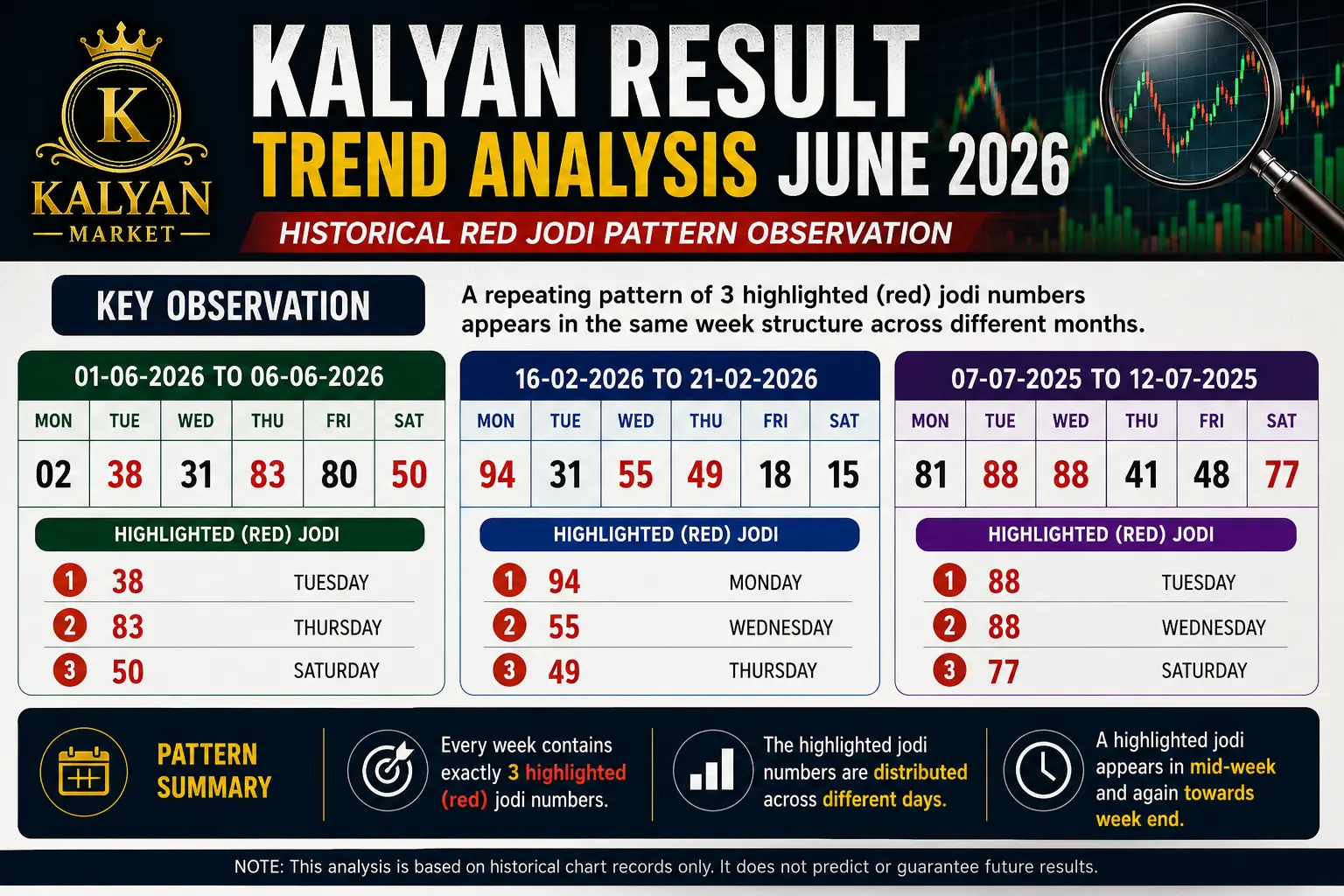
The first week of June 2026 produced an interesting pattern within the Kalyan Matka Guide chart records. While reviewing weekly data from 01-06-2026 to 06-06-2026, a recurring structure emerged involving highlighted red jodi values appearing across different days of the week.
Instead of reviewing individual daily outcomes, this analysis focuses on the overall weekly layout and compares it with historical data available in the Satta Matka Result Today archive and older Archived Historical Records from February 2026 and July 2025. The objective is to document actual observations from archived data rather than provide generic explanations.
Key Findings Summary
Three highlighted red jodi values appeared during the first week of June 2026:
- 38 (Tuesday)
- 83 (Thursday)
- 50 (Saturday)
When older chart records were examined, similar weekly structures were identified in:
- 16 February 2026 to 21 February 2026
- 07 July 2025 to 12 July 2025
Although the exact numbers and weekdays differ, all three weeks contain a similar pattern involving three highlighted entries distributed throughout the week.
Trend Analysis
June 2026 Weekly Layout
The first week of June 2026 recorded on the Kalyan Jodi Chart contained the following values:
Among these values, three entries were highlighted in red:
- 38
- 83
- 50
Rather than appearing consecutively, the highlighted values were spread across separate positions within the week. This creates a distinctive visual structure when reviewing the chart.
Distribution Pattern
A notable observation is the spacing between highlighted entries. The values do not appear back-to-back. Instead, they are separated by standard entries, creating a balanced distribution across the weekly record.
Frequency Analysis
| Week | Highlighted Entries | Total |
|---|---|---|
| to | 38, 83, 50 | 3 |
| to | 94, 55, 49 | 3 |
| to | 88, 88, 77 | 3 |
The most important observation is consistency. Each weekly block contains exactly three highlighted red jodi values.
Market Observations
Observation 1: Triple Highlight Structure
All three historical examples contain three highlighted entries within a six-day weekly block.
Observation 2: Mid-Week Appearance
At least one highlighted value appears during the middle portion of the week in each dataset.
Observation 3: Late-Week Highlight
Every compared week includes a highlighted value toward the closing portion of the weekly sequence.
Historical Comparison
June 2026 vs February 2026
The week from 16 February 2026 to 21 February 2026 recorded:
Highlighted values:
- 94
- 55
- 49
While the numbers themselves differ from June 2026, the overall weekly structure remains similar. Both weeks contain three highlighted entries positioned across different sections of the week.
June 2026 vs July 2025
The week from 07 July 2025 to 12 July 2025 recorded:
Highlighted values:
- 88
- 88
- 77
Again, the same broader structure appears. Three highlighted entries are present across the six-day period, creating a comparable weekly pattern.
What This Data Shows
The comparison between June 2026, February 2026 and July 2025 demonstrates a recurring chart structure. Although the exact jodi values are different, the weekly distribution pattern is remarkably similar.
Each week contains three highlighted red entries positioned across separate days rather than appearing consecutively.
This observation does not indicate forecasting ability and should not be interpreted as a prediction. Instead, it highlights how certain chart layouts can recur within historical Verified Historical Results. For a broader examination of the available historical Kalyan dataset, see our Kalyan historical analysis, which covers historical frequencies, result distributions and period comparisons. For comparison with other major markets, readers can also review the Main Bazar Trend Analysis or the Rajdhani Trend Analysis.
Frequently Asked Questions
What trend was observed during the first week of June 2026?
The week contained three highlighted red jodi values: 38, 83 and 50.
Was the same pattern found in historical records?
Yes. Similar weekly structures were identified in February 2026 and July 2025 records.
How many highlighted entries appeared in each compared week?
Each selected week contained exactly three highlighted entries.
Does this article predict future Kalyan Result outcomes?
No. The article only documents historical observations from archived records.
Why compare multiple historical weeks?
Comparing several periods helps identify recurring structures and frequencies that may not be visible when studying a single week in isolation.
Conclusion
The first week of June 2026 provides an interesting example of recurring historical chart structures within Kalyan Results records. The highlighted values 38, 83 and 50 form a weekly distribution that closely resembles layouts found during February 2026 and July 2025.
While the actual numbers differ, the presence of three highlighted entries distributed across the week appears consistently across all three datasets. For historical chart researchers, documenting these recurring structures adds valuable context to long-term market record analysis.