Analysis Snapshot
- Market: Rajdhani Day & Night
- Observation Period: 15 June – 27 June 2026
- Weeks Analysed: 2
- Highlighted Results: 9
- Repeated Digits: 6, 5, 2, 4
- Purpose: Historical Analysis
Quick Facts
- Market: Rajdhani
- Analysis Period: 15–27 June 2026
- Markets: Day + Night
- Analysis Type: Historical
- Data Source: Archived Results
- Content Updated: July 2026
Introduction
This analysis reviews archived Rajdhani Day Matka Result and Rajdhani Night Matka Result records collected from the final two weeks of June 2026. Instead of attempting to forecast future outcomes, the purpose of this page is to document historical observations, repeated digit appearances, weekly result distribution, and chart-based patterns. Such archived summaries make it easier to compare different weeks and understand how result records evolved over time.
Users looking for current market updates can check the homepage for Satta Matka updates alongside this historical report. Additionally, other major indices like Kalyan Results and Verified Historical Results databases can be checked for comparative historical context.
Key Findings Summary
The archived records highlight several notable observations across both Rajdhani Day and Rajdhani Night markets. Rajdhani Day displayed a higher concentration of highlighted (red) results than Rajdhani Night during the observed period. Multiple repeated digits were also identified in both open and close positions, while some weeks showed stronger clustering of full red entries than others.
- Rajdhani Day recorded three consecutive highlighted results during the week of –.
- Rajdhani Day showed both full red and half red entries during the following week, creating a more balanced distribution.
- Rajdhani Night contained fewer highlighted entries but still presented identifiable historical relationships between closing digits.
- Repeated open and close digits were visible across multiple weekdays, making the archive useful for historical comparison.
- The observed records demonstrate that weekly archives can reveal distribution changes even within a short historical period.
Rajdhani Day Weekly Trend Analysis
Week: –
During this week, Rajdhani Day produced one of the strongest concentrations of highlighted entries within the available archive. Tuesday recorded the full red jodi 55, followed by 99 on Thursday and 44 on Friday. Three full red values appearing within the same week created a noticeable cluster rather than an evenly distributed sequence.
Another important historical observation was the repetition of the open digit 6. The same open digit appeared on Monday, Wednesday, and Saturday, indicating a recurring occurrence across three separate trading days within the weekly archive. Although repeated digits are common in historical datasets, documenting these occurrences helps improve long-term archive comparisons.
Week: –
The following week presented a more varied distribution. Instead of consecutive full red values, the archive contained a combination of half red and full red results. Monday opened with the half red value 27, Wednesday recorded the full red value 00, and Saturday concluded with another half red entry, 50.
Compared with the previous week, highlighted entries were spread more evenly throughout the week instead of forming a continuous cluster. This variation demonstrates how historical result distributions can shift significantly from one weekly archive to the next.
Rajdhani Day Structured Results
| Date | Day | Result | Status |
|---|---|---|---|
| Monday | 68 | Standard | |
| Tuesday | 55 | Full Red | |
| Wednesday | 63 | Standard | |
| Thursday | 99 | Full Red | |
| Friday | 44 | Full Red | |
| Saturday | 61 | Standard | |
| Monday | 27 | Half Red | |
| Tuesday | 25 | Standard | |
| Wednesday | 00 | Full Red | |
| Thursday | 29 | Standard | |
| Friday | 84 | Standard | |
| Saturday | 50 | Half Red |
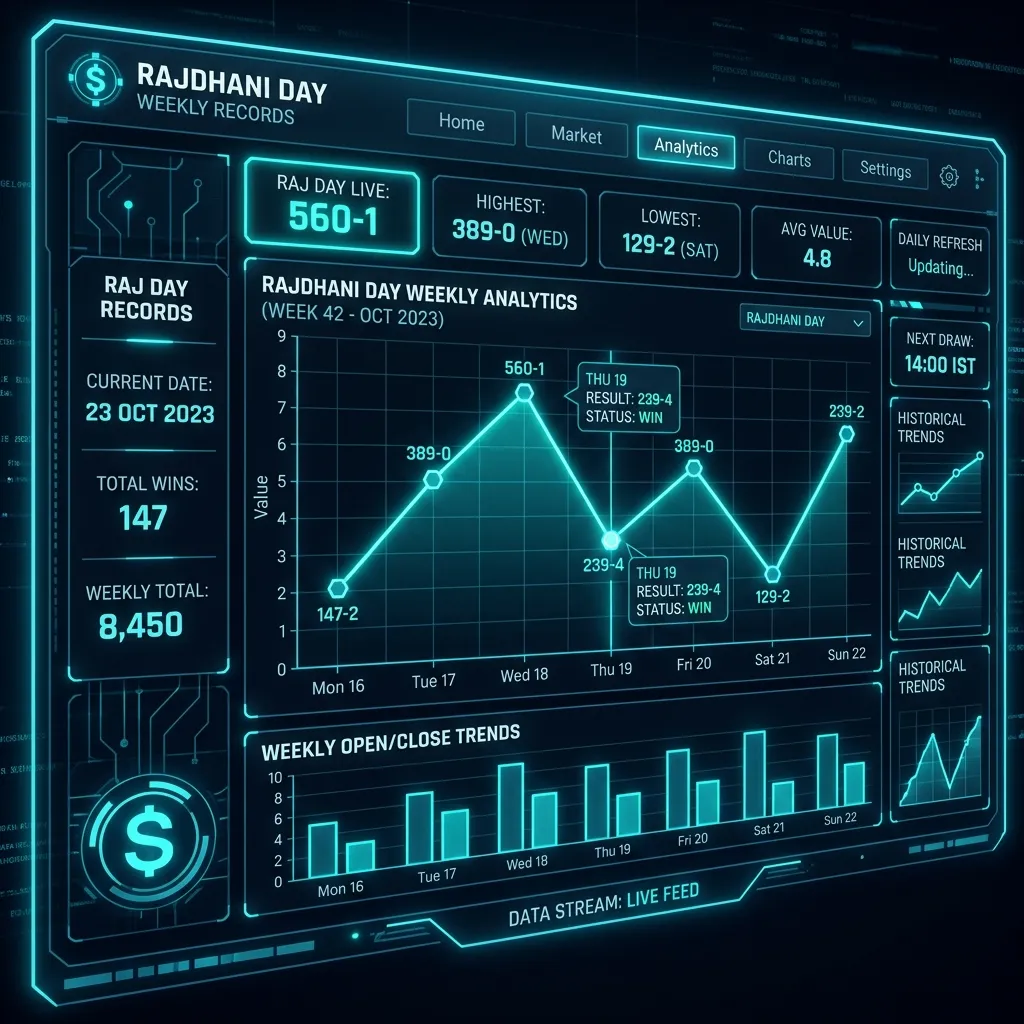
Rajdhani Day Statistics
| Week | Full Red | Half Red | Repeated Digits |
|---|---|---|---|
| Week 1 | 3 | 0 | 1 |
| Week 2 | 1 | 2 | 2 |
Rajdhani Day Frequency Analysis
Repeated Open Digits
The historical archive revealed two clear examples of repeated open digits. During the week of –, the open digit 6 appeared three separate times on Monday, Wednesday, and Saturday. During the following week, the open digit 2 appeared multiple times, creating another observable repetition within the archive.
Repeated Closing Digits
The closing digit 5 appeared twice during the week of –, specifically on Tuesday and Thursday. Repeated closing digits such as these contribute to historical frequency analysis and make archived records easier to compare across multiple weeks.
Highlighted Result Distribution
The two archived weeks displayed different patterns of highlighted values. The first week was dominated by three consecutive full red entries (55, 99, and 44), while the second week contained a combination of half red values (27 and 50) alongside the full red value 00. This change illustrates how highlighted results may become more concentrated during one period and more evenly distributed during another.
Visual Observations
Observation
Open digit 6 repeated three times.
Impact: Strong weekly repetition.
Archive Reference: 15–20 June.
Observation
Open digit 2 repeated multiple times.
Impact: Concentrated open frequency.
Archive Reference: 22–27 June.
Observation
Closing digit 5 repeated twice.
Impact: Balanced closing distribution.
Archive Reference: 22–27 June.
Historical Observations
- Three full red values occurred within a single week (55, 99, 44).
- The following week recorded one full red value (00) together with two half red entries (27 and 50).
- Open digit 6 appeared three times in one week.
- Open digit 2 repeated during the following week.
- Closing digit 5 occurred twice within the same weekly archive.
- The distribution of highlighted entries shifted noticeably between consecutive weeks.
Rajdhani Night Weekly Trend Analysis
Week: –
The Rajdhani Night archive for this week displayed a relatively balanced result distribution with only one highlighted entry. Tuesday recorded the half red jodi 50, while the remaining days were distributed across different values without forming a concentrated sequence of highlighted results. Compared with Rajdhani Day during the same period, the Night market showed fewer highlighted outcomes and a more evenly spread weekly pattern.
One of the most noticeable observations from this week was the repetition of the open digit 4. The digit appeared on both Wednesday and Thursday, making it the only direct repeated open digit recorded during the observed period. Although only two occurrences were found, documenting repeated digits provides useful reference material for historical archive comparisons.
Week: –
The following week presented stronger highlighted activity. Wednesday recorded the full red jodi 33, followed immediately by another full red result, 55, on Thursday. Unlike the previous week, highlighted entries occurred consecutively, creating a more concentrated distribution within the middle of the week.
No direct repetition of open or closing digits was identified during this archive period. However, an interesting relationship was observed between the values 04 and 19. The closing digit of 04 is 4, while the closing digit of 19 is 9. Within historical chart discussions, these values are sometimes noted as complementary or "cut" relationships because each value references the other through its closing digit. While this observation is documented within archived records, it should be interpreted only as a historical characteristic rather than a predictive pattern.
Rajdhani Night Structured Results
| Date | Day | Result | Status |
|---|---|---|---|
| Monday | 12 | Standard | |
| Tuesday | 50 | Half Red | |
| Wednesday | 48 | Standard | |
| Thursday | 41 | Standard | |
| Friday | 93 | Standard | |
| Monday | 76 | Standard | |
| Tuesday | 04 | Standard | |
| Wednesday | 33 | Full Red | |
| Thursday | 55 | Full Red | |
| Friday | 19 | Standard |
Historical Comparison: Rajdhani Day vs Rajdhani Night
Comparing both Rajdhani markets during the observed period highlights several differences in weekly result distribution. Rajdhani Day produced a greater number of highlighted entries, including multiple full red values within a single week. Rajdhani Night, on the other hand, displayed fewer highlighted records but maintained a steadier overall distribution across weekdays.
The first observed week clearly favored Rajdhani Day in terms of highlighted activity, recording three full red entries (55, 99 and 44), whereas Rajdhani Night produced only one half red value (50). During the second week, the difference narrowed as Rajdhani Day recorded a combination of half red and full red values while Rajdhani Night generated two consecutive full red entries (33 and 55).
Digit repetition also differed between the two markets. Rajdhani Day demonstrated repeated open digits (6 and 2) as well as repeated closing digit 5. Rajdhani Night showed only one direct repetition through open digit 4, while also presenting the historical cut relationship observed between 04 and 19.
These differences demonstrate that separate historical analysis for Rajdhani Day and Rajdhani Night provides greater clarity than combining both datasets into a single weekly summary. Detailed tracking parameters can also be referenced using tools like Jodi Chart, Panel Chart, and the wider Historical Chart Archives references.
Rajdhani Day vs Rajdhani Night Parameters
| Metric | Rajdhani Day | Rajdhani Night |
|---|---|---|
| Weeks | 2 | 2 |
| Full Red | 4 | 2 |
| Half Red | 2 | 1 |
| Repeated Open Digits | 6, 2 | 4 |
| Repeated Close Digits | 5 | None |
Market Observations from the Archived Records
Several meaningful observations emerged from the available historical data. First, highlighted entries were not evenly distributed across every week. Instead, they appeared in clusters during specific periods before returning to a more balanced distribution in the following archive.
Second, repeated open and closing digits were limited to only a few values. Rather than every digit appearing with equal frequency, certain digits occurred multiple times within a short period. These recurring values become valuable reference points when comparing archived records over longer periods.
Another notable characteristic was the contrast between the two Rajdhani markets. Rajdhani Day experienced greater variation in highlighted entries, while Rajdhani Night remained comparatively stable except for the consecutive appearance of 33 and 55 during the second week.
These observations demonstrate the value of maintaining structured historical archives. Recording weekly summaries allows readers to compare distribution changes, identify recurring values, and better understand how archived records differ from one week to another without drawing predictive conclusions. To study other markets, see the Milan Day Result and Milan Night Result logs.
Data Source
The observations presented on this page are derived from archived Rajdhani Day and Rajdhani Night result records available on FixResult.in for the selected historical period.
Key Takeaways
- ✓ Three Full Red entries observed in Rajdhani Day.
- ✓ Open digit 6 appeared three times.
- ✓ Closing digit 5 repeated twice.
- ✓ Rajdhani Night showed fewer highlighted values.
- ✓ Historical comparison shows changing weekly distribution.
Frequently Asked Questions
What does this Rajdhani Result Trend Analysis cover?
This page analyzes archived Rajdhani Day and Rajdhani Night results from the selected historical period. It summarizes weekly observations, repeated digits, highlighted results, and frequency patterns to provide a structured historical reference instead of focusing on individual daily records.
How was the historical analysis prepared?
The analysis was created using archived weekly Rajdhani result records. Each week was reviewed separately to identify repeated open digits, repeated closing digits, highlighted jodi values, and overall distribution trends before comparing both Rajdhani Day and Rajdhani Night markets.
Which repeated values were observed in this archive?
Rajdhani Day showed repeated open digits 6 and 2 during different weeks, while closing digit 5 appeared twice in one archive period. Rajdhani Night recorded repeated open digit 4 and also displayed an interesting historical relationship between the archived values 04 and 19.
Does this analysis predict future Rajdhani results?
No. Every observation on this page is based entirely on historical records. The content documents archived data for research and reference purposes only and should not be interpreted as a prediction or recommendation.
Why are historical result archives useful?
Historical archives allow readers to compare different weeks, identify recurring observations, review digit frequency, and understand how result distributions change over time. Organized archives also improve long-term record management and chart reference.
Why are Rajdhani Day and Rajdhani Night analyzed separately?
Although both belong to the Rajdhani market, Rajdhani Day and Rajdhani Night maintain separate result histories. Independent analysis makes historical comparisons clearer and provides more accurate documentation of each market's archived records.